
 Cyvena
 — AI-assisted Meta ad insights, with human control.
Cyvena (cyvena.com) is c2me’s daily Meta ads insight system for media buyers and business owners.
This page covers one thing only: the role AI plays inside Cyvena, and the limits we put around it.
Rules flag. AI explains and drafts. People approve.
Cyvena splits the work into three roles. AI is one of them — it never holds all three.
Flag and constrain
A deterministic rules engine and guardrails make the ad decisions. Anomaly scores are statistical, not generated by a language model.
Explain and draft
AI explains the likely cause behind what the rules flagged, writes it for each reader, and drafts reports, copy and suggestions for review.
Review and approve
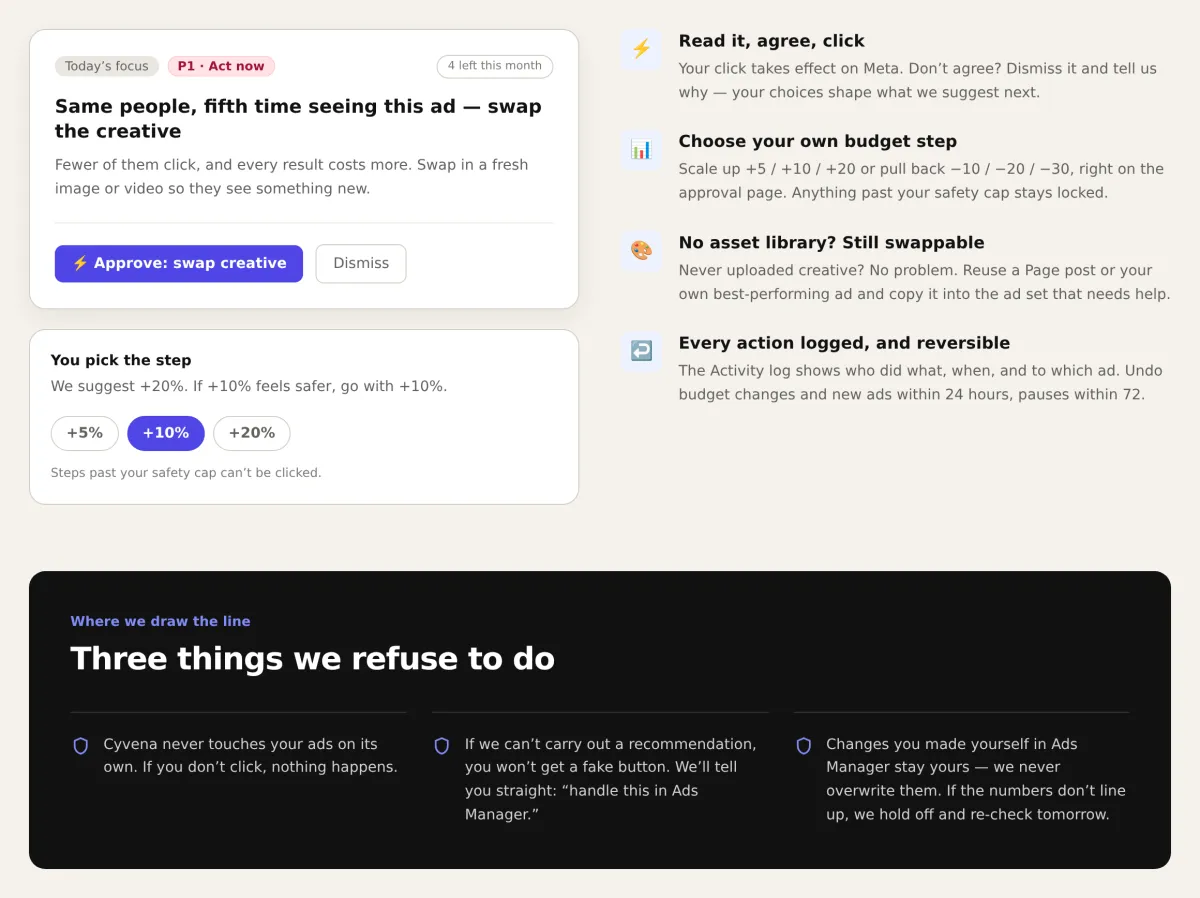
Autopilot runs in one of three modes. Actions run only after a one-click approval, and they can be undone.
One worked example
Illustrative example, sample data- 1Rules
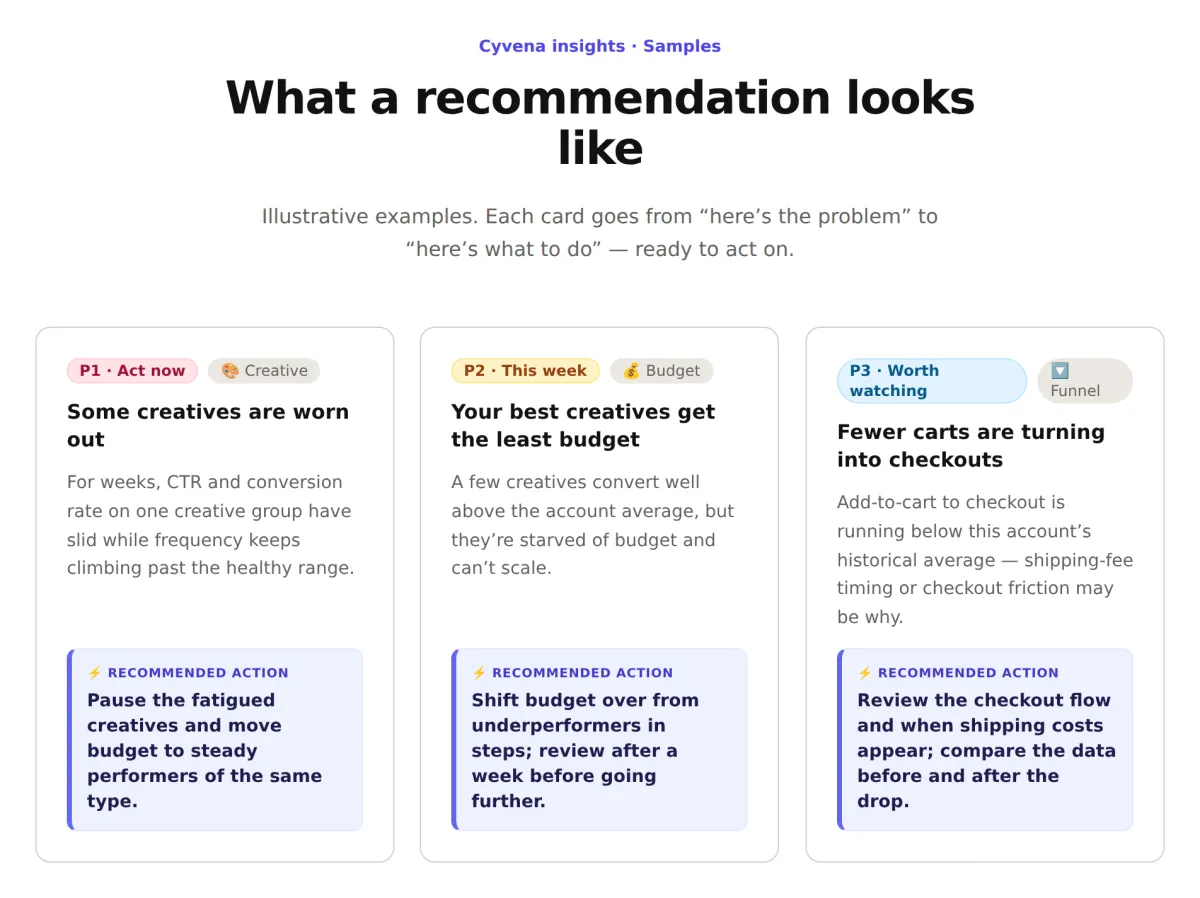
A rule flags creative fatigue
Frequency on one creative group has stayed above the healthy range for 5 days. This flag comes from the rules engine, not from AI.
- 2AI
AI explains it in two voices
For the media buyerFrequency has been above the healthy range 5 days running while CTR and conversion rate slid. Likely cause: creative fatigue in this group.
For the ownerThe same people keep seeing these ads, so fewer of them click and each result costs more. A fresh creative is the likely fix.
Cites only ad IDs from its own data snapshot: AD-1201AD-1204
- 3AI
A suggested action
Pause the 2 most fatigued creatives and shift budget to stable creatives of the same type.
- 4People
The owner decides
Nothing changes on Meta until the owner approves. Rejecting is one click too.
Where AI does the work
Grouped by what the AI is doing. Every item below either feeds a person’s decision or waits for one.
Understand
- Extracts brand voice, selling points and claims to avoid from the client’s website. Site text is treated as data, never as instructions.
- A vision classifier screens website images (excluding before/after, treatment and text-overlay images) and checks image and video quality.
- Plans audience personas in two passes: proposes 5–10 personas and interests, then checks them against Meta interest search and removes wrong or ambiguous matches. It proposes; it does not create ad sets.
Explain
- Daily insight cards: rules screen first, AI explains the likely cause, with an operator view and a plain-language owner view, plus a vision summary of what the best and worst creatives have in common.
- Weekly and monthly report drafts in a “numbers → problem → fix” form.
- A read-only Q&A assistant over the account’s data snapshot. It never writes to Meta.
Create
- Ad copy and title drafts, held as pending until the owner approves; a phrase filter triggers up to 3 rewrites. Rolling out
- Image generation in Image Studio with OpenAI gpt-image-2.
Review
- A monthly review of the last 30 days of rule decisions and outcomes, producing rule-change suggestions that the owner adopts or rejects. The AI never edits rules itself.
The daily email is where most of this lands
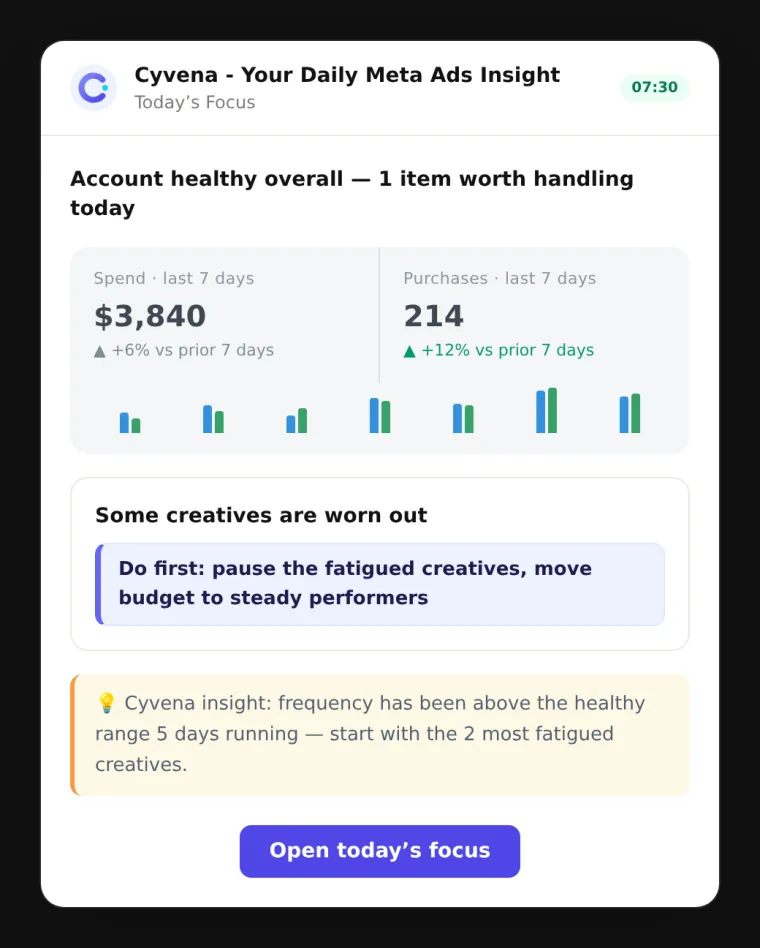
Every morning the owner gets a short email: trends, the one or two things worth handling today, and the AI’s plain-language explanation of the likely cause. Acting on it still means logging in and approving.
Guardrails
The limits are enforced by the system around the model, not left to the model.
- Cites only ad IDs present in its own data snapshot. Invalid cards are quarantined, regenerated once, then dropped.
- Fail-closed: if the AI step fails, no card is shown.
- The Q&A assistant is read-only.
- Human approval for copy, rule-change suggestions and Meta recommendations.
- Deterministic action rules with observe and approve modes, plus undo.
- Website text is treated as data, never as instructions.
- Per-account consent for AI data processing. Rolling out
How it’s built
Cyvena uses Anthropic Claude models for analysis, writing and visual understanding, and OpenAI gpt-image-2 (via Codex on a ChatGPT subscription) for image generation in Image Studio.
Cyvena is built with a cross-model workflow. GPT, via Codex on a ChatGPT subscription, is used as an independent adversarial reviewer for architecture, security and AI-logic decisions. One example: the insight validator that blocks hallucinated ad IDs was rebuilt after a two-round GPT debate showed that the prompt and the validator had opposite policies for handling conflicts. Using a second model to challenge the first is how we find our own blind spots.
Want to see how AI fits your ad workflow?
Talk to us, or see the product itself at cyvena.com.